AI and SEO: What Business Owners Need to Know
Introduction
Search engine optimization has changed dramatically over the last few years. Businesses that once focused only on keywords and backlinks are now adapting to an entirely new landscape shaped by artificial intelligence. Search engines are becoming smarter, user expectations are increasing, and AI-powered search experiences are changing how customers discover products and services.
If you own a small business, startup, or local company, understanding the relationship between AI and SEO is no longer optional. Businesses that embrace AI strategically can create better content, improve user experience, automate repetitive SEO tasks, and increase organic visibility. On the other hand, businesses that rely solely on outdated SEO tactics risk losing rankings and valuable customers. The good news is that AI isn’t replacing SEO—it is making SEO more intelligent. Human expertise, creativity, and strategy remain essential, while AI helps speed up research, analysis, and optimization.
This guide explains everything business owners need to know about AI and SEO, how search is evolving, and how you can use AI responsibly to grow your online presence.
What Is AI and SEO? (Featured Snippet Answer)
AI and SEO refer to using artificial intelligence to improve search engine optimization by helping businesses research keywords, create high-quality content, optimize websites, analyze competitors, improve technical SEO, and better understand user intent. AI makes SEO more efficient, but successful rankings still require human expertise, valuable content, and an excellent website experience.
AI and SEO at a Glance
| Area | Traditional SEO | AI-Powered SEO |
|---|---|---|
| Keyword Research | Manual research | AI discovers opportunities faster |
| Content Writing | Human only | Human + AI collaboration |
| Technical SEO | Time-consuming audits | Automated issue detection |
| User Intent | Manual analysis | AI identifies search intent patterns |
| Content Optimization | Manual editing | AI recommendations |
| Competitor Analysis | Hours of research | Minutes with AI |
| SEO Reporting | Manual reports | Automated dashboards |
| Search Experience | Keyword matching | Intent-based answers |
Why AI Is Changing SEO
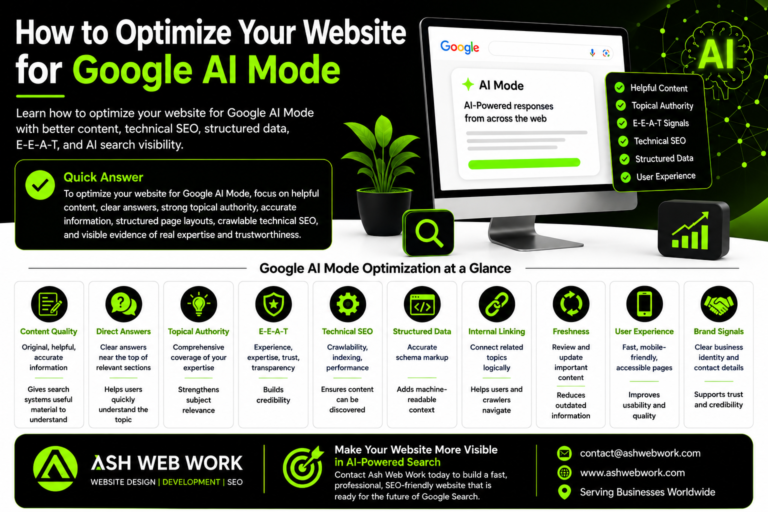
Artificial intelligence has fundamentally changed how search engines understand websites. Modern search engines no longer rank pages based only on exact-match keywords. Instead, they evaluate:
- User intent
- Context
- Topical authority
- Website quality
- Trustworthiness
- User experience
- Content freshness
- Helpful information
AI enables search engines to interpret natural language more accurately, meaning businesses must create content that genuinely answers users’ questions rather than simply repeating keywords. This shift rewards businesses that prioritize expertise and usefulness over shortcuts.
How AI Is Transforming Search
1. Search Engines Understand Intent Better
Years ago, ranking often depended on repeating a keyword several times throughout a page. Today, AI allows search engines to understand what users actually mean. For example, when someone searches: “Best website for a local bakery”. The search engine understands the person may also be looking for:
- Affordable web design
- Mobile-friendly websites
- SEO services
- Local business websites
- Fast-loading websites
This means your content should comprehensively address related topics instead of focusing on one keyword.
2. AI Search Delivers Direct Answers
Traditional search showed ten blue links. Modern AI-powered search often provides direct summaries before users even click a website. Businesses now need content that:
- Answers questions clearly
- Uses structured headings
- Includes concise definitions
- Provides actionable advice
- Demonstrates authority
Optimizing for AI-generated answers increases the chances of your content being cited in search summaries.
3. User Experience Is Now a Ranking Factor
AI evaluates how users interact with your website. Important signals include:
- Page speed
- Mobile responsiveness
- Navigation
- Readability
- Accessibility
- Engagement
- Time on page
- Bounce rate
A technically optimized website combined with valuable content performs better in both traditional and AI-powered search.
Benefits of AI for SEO
Artificial intelligence helps businesses work smarter rather than replacing SEO professionals.
Faster Keyword Research
AI tools analyze millions of search queries quickly. Benefits include:
- Finding long-tail keywords
- Identifying search intent
- Discovering content gaps
- Uncovering trending topics
- Grouping related keywords
Instead of spending hours researching manually, businesses can create a targeted SEO strategy much faster.
Better Content Planning
AI helps identify:
- Popular questions
- Related topics
- Missing content
- Seasonal opportunities
- Emerging trends
This allows businesses to build comprehensive content clusters that establish topical authority.
Improved Content Optimization
AI can recommend improvements such as:
- Better headings
- Improved readability
- Internal linking opportunities
- Semantic keywords
- Content structure
- Meta descriptions
- Title suggestions
However, these suggestions should always be reviewed by a human editor to ensure accuracy and originality.
Smarter Competitor Analysis
AI tools can quickly evaluate competitor websites by analyzing:
- Ranking keywords
- Content gaps
- Backlink opportunities
- Page structure
- Content length
- Search visibility
These insights help businesses identify opportunities without spending days on manual research.
Technical SEO Automation
Many technical SEO tasks can now be partially automated, including:
- Broken link detection
- Duplicate content checks
- Missing metadata
- Crawl errors
- Sitemap monitoring
- Image optimization recommendations
- Page performance reports
Automation saves time while allowing business owners to focus on growth.
AI-Powered SEO Tasks Every Business Should Use
AI works best when it enhances—not replaces—your SEO efforts.
Keyword Research
AI can generate:
- Primary keywords
- Related keywords
- Long-tail keywords
- Question-based searches
- Semantic keyword groups
Always validate search volume and competition using trusted SEO tools before finalizing your strategy.
Content Brief Creation
Before writing an article, AI can help create:
- Content outlines
- H2 and H3 headings
- Search intent analysis
- FAQ ideas
- Topic clusters
- Internal linking suggestions
This speeds up planning while ensuring comprehensive coverage.
Meta Titles and Descriptions
AI can generate multiple variations of:
- SEO titles
- Meta descriptions
- Social media snippets
Choose the versions that best reflect your brand voice and encourage clicks.
Content Optimization
After publishing, AI tools can identify:
- Thin sections
- Missing keywords
- Readability issues
- Over-optimization
- Opportunities to answer additional user questions
Continuous optimization helps maintain rankings over time.
Popular AI Tools That Support SEO
While no single tool can handle every aspect of SEO perfectly, combining AI with trusted SEO platforms can significantly improve efficiency. Here are some of the most useful categories of AI-powered tools:
AI Writing Assistants
Useful for:
- Content outlines
- Draft generation
- Content expansion
- Grammar improvements
- Rewriting paragraphs
- Brainstorming ideas
Remember to edit AI-generated content thoroughly to ensure originality, accuracy, and brand consistency.
SEO Research Platforms
These tools help with:
- Keyword research
- Competitor analysis
- Content gap analysis
- Ranking tracking
- Backlink monitoring
- Technical SEO audits
They provide data that AI writing tools alone cannot.
Technical SEO Tools
Technical optimization platforms can automatically detect:
- Crawl issues
- Broken links
- Slow pages
- Redirect chains
- Duplicate metadata
- Missing image alt text
- Core Web Vitals issues
Fixing these problems improves both search visibility and user experience.
Analytics and Performance Tools
AI-enhanced analytics can reveal:
- Which pages generate the most traffic
- Where visitors leave your site
- Which keywords convert
- User behavior patterns
- Content engagement
- Opportunities for improvement
These insights help you make data-driven SEO decisions instead of relying on guesswork.
Why It Matters
AI is reshaping how customers search for information, compare businesses, and make purchasing decisions. Business owners who understand AI-powered SEO are better positioned to attract qualified traffic, build trust, and stay competitive. For small businesses and startups, AI offers an opportunity to compete more efficiently by automating repetitive tasks, uncovering keyword opportunities, and improving content quality. However, success still depends on creating authentic, helpful content and maintaining a technically sound website.
Common Mistakes to Avoid
Many businesses misuse AI, which can hurt rather than help their SEO performance. Avoid these common mistakes:
- Publishing AI-generated content without editing or fact-checking.
- Relying solely on AI instead of understanding user intent.
- Ignoring technical SEO issues like slow page speed and broken links.
- Keyword stuffing instead of writing naturally.
- Creating large amounts of thin, low-value content.
- Forgetting to update older articles with fresh information.
- Neglecting internal linking and content structure.
- Failing to add original examples, insights, or real-world experience.
Remember, AI is a tool—not a substitute for expertise.
Best Practices for AI-Powered SEO
To get the most value from AI while maintaining high-quality SEO, follow these best practices:
- Use AI for research, planning, and optimization—not as a replacement for human expertise.
- Focus on solving real customer problems with clear, helpful content.
- Build topic clusters that establish authority in your niche.
- Regularly update content to keep it accurate and relevant.
- Optimize for user intent rather than just keywords.
- Improve Core Web Vitals, mobile responsiveness, and website speed.
- Use descriptive headings, internal links, and structured content for better readability.
- Monitor performance using analytics and refine your strategy based on real data.
- Add original insights, case studies, or business experience to strengthen E-E-A-T.
- Combine AI efficiency with professional editing to ensure trustworthiness and brand consistency.
AI SEO for Local Businesses
Artificial intelligence is changing local SEO just as rapidly as traditional SEO. Whether you own a restaurant, law firm, clinic, retail store, salon, or service-based business, AI-powered search is helping customers discover businesses based on context—not just keywords. For example, someone searching:
- “best website designer near me”
- “affordable SEO agency for small business”
- “WordPress developer for local business”
may receive AI-generated recommendations that summarize businesses, reviews, website quality, and services before they even click a link. To improve visibility in AI-powered local search:
Optimize Your Business Profile
Keep your business information accurate across all platforms. Ensure you have:
- Consistent business name
- Correct address
- Phone number
- Business hours
- Website URL
- Categories
- Updated photos
- Customer reviews
Consistency builds trust with both users and search engines.
Create Local Content
Instead of writing only general articles, publish content that targets your local audience. Examples include:
- Website Design Services in Dehradun
- SEO Tips for Small Businesses in Uttarakhand
- Best eCommerce Website Solutions for Local Retailers
- Local Digital Marketing Checklist
Location-specific content increases your chances of appearing for relevant searches.
Encourage Customer Reviews
Positive reviews remain one of the strongest local ranking signals. Ask satisfied customers to leave honest reviews after completing a project. Respond professionally to every review—positive or negative—to demonstrate that your business values customer feedback.
Build Local Authority
AI search favors businesses that demonstrate real expertise. You can build authority by publishing:
- Case studies
- Success stories
- Client testimonials
- Industry guides
- Helpful blog posts
- Frequently asked questions
Businesses that consistently educate their audience are more likely to be referenced in AI-generated search answers.
The Future of AI and SEO
AI is not replacing SEO—it is redefining it. Over the next few years, businesses can expect several major trends.
More Conversational Search
People increasingly search using complete questions instead of short phrases. For example:
Instead of: “SEO company”
Users now ask: “Who provides affordable SEO services for small businesses?”
Your content should answer questions naturally rather than targeting isolated keywords.
Greater Focus on Expertise
Search engines are becoming better at identifying:
- First-hand experience
- Expert opinions
- Helpful insights
- Trustworthy sources
Businesses that publish genuine, experience-based content will have an advantage over those producing generic articles.
AI-Powered Personalization
Future search results will become more personalized based on:
- User behavior
- Preferences
- Location
- Previous searches
- Device type
This means businesses should focus on delivering excellent experiences for different customer segments rather than relying on one-size-fits-all content.
Increased Importance of Website Quality
Fast, secure, mobile-friendly websites will continue to outperform poorly optimized competitors. Even the best content may struggle if your website loads slowly or provides a poor user experience.
Human Creativity Will Remain Essential
AI can help generate ideas, analyze data, and improve efficiency. However, it cannot replace:
- Original experiences
- Customer relationships
- Brand personality
- Strategic thinking
- Industry expertise
- Creative storytelling
The most successful businesses will combine AI with human knowledge rather than depending entirely on automation.
Key Takeaways
| Area | Best Practice |
|---|---|
| Content | Write for people first, search engines second |
| AI | Use AI to assist—not replace—human expertise |
| Keywords | Focus on search intent and topical relevance |
| Website | Improve speed, usability, and mobile experience |
| Local SEO | Optimize business listings and publish local content |
| Technical SEO | Regularly monitor and fix website issues |
| E-E-A-T | Demonstrate expertise through original, trustworthy content |
| Long-Term Success | Combine AI efficiency with consistent SEO strategy |
Frequently Asked Questions
1. Does AI replace SEO?
No. AI enhances SEO by automating research, analysis, and optimization, but it does not replace the need for strategy, technical expertise, or high-quality content. Businesses still need human oversight to create accurate, trustworthy, and engaging content that satisfies user intent.
2. Can AI-generated content rank on Google?
Yes, AI-assisted content can rank if it is original, accurate, helpful, and demonstrates expertise. Search engines evaluate content quality rather than the method used to create it. Articles should always be reviewed, edited, and enriched with real-world insights before publication.
3. Which SEO tasks can AI automate?
AI can assist with:
- Keyword research
- Content outlines
- Topic ideas
- Meta titles
- Meta descriptions
- Internal linking suggestions
- Technical SEO audits
- Competitor analysis
- Performance reporting
Strategic decision-making, brand messaging, and final editing should still be handled by experienced professionals.
4. Is AI useful for small businesses?
Absolutely. AI allows small businesses to compete more efficiently by reducing the time spent on repetitive SEO tasks. It helps uncover keyword opportunities, generate content ideas, improve website optimization, and monitor performance, making professional SEO more accessible even with limited resources.
5. How does AI affect local SEO?
AI improves local search by better understanding user intent and context. Businesses with complete profiles, strong reviews, location-specific content, and high-quality websites are more likely to appear in AI-generated local search recommendations.
6. What are the biggest risks of relying too heavily on AI?
Common risks include:
- Publishing inaccurate information
- Producing generic content
- Losing brand voice
- Creating duplicate or low-value pages
- Ignoring user experience
- Neglecting fact-checking
The best results come from combining AI with human expertise and editorial review.
7. How can Ash Web Work help businesses succeed with AI and SEO?
Ash Web Work helps businesses integrate AI into a complete SEO strategy by offering:
- Professional website design
- WordPress development
- Technical SEO optimization
- Content strategy
- Local SEO services
- Website speed optimization
- Conversion-focused design
- Ongoing SEO support
Rather than relying solely on automation, Ash Web Work combines AI-powered insights with proven digital marketing strategies to help businesses achieve sustainable organic growth.
Conclusion
Artificial intelligence is transforming how search engines understand websites, evaluate content, and connect users with relevant information. For business owners, this shift presents an opportunity to improve efficiency, create better content, and deliver stronger user experiences. However, AI is not a shortcut to higher rankings. Long-term SEO success still depends on publishing helpful content, maintaining a fast and secure website, earning trust, and consistently meeting customer needs.
Businesses that combine AI tools with human expertise will be better equipped to adapt to changing search algorithms, attract qualified traffic, and convert visitors into loyal customers. Whether you’re building a new website or improving an existing one, investing in AI-assisted SEO today can position your business for long-term online success.
Call to Action
Your website should do more than simply exist—it should generate traffic, build credibility, and convert visitors into paying customers.
At Ash Web Work, we help small businesses, startups, and local companies combine modern AI-powered SEO strategies with professional website design, WordPress development, technical optimization, and conversion-focused digital marketing.
Whether you need a faster website, higher search rankings, improved local visibility, or a complete online growth strategy, our team is ready to help.
Contact Ash Web Work today for a personalized SEO and website consultation, and discover how AI-driven optimization can help your business attract more organic traffic, generate more qualified leads, and achieve sustainable growth in 2026 and beyond.