How to Optimize Your Website for Google AI Mode
Introduction
Google Search is evolving beyond the traditional list of ten blue links. With AI-powered search experiences such as Google AI Mode, users can ask longer, more detailed questions and receive AI-generated responses that may combine information from multiple sources. For website owners, this creates an important question: How do you optimize a website for Google AI Mode?
The answer is not to abandon traditional SEO or chase a secret “AI Mode ranking trick.” Instead, businesses need to create content that is easy to understand, technically accessible, genuinely useful, and supported by real expertise.
Quick Answer: How to Optimize for Google AI Mode
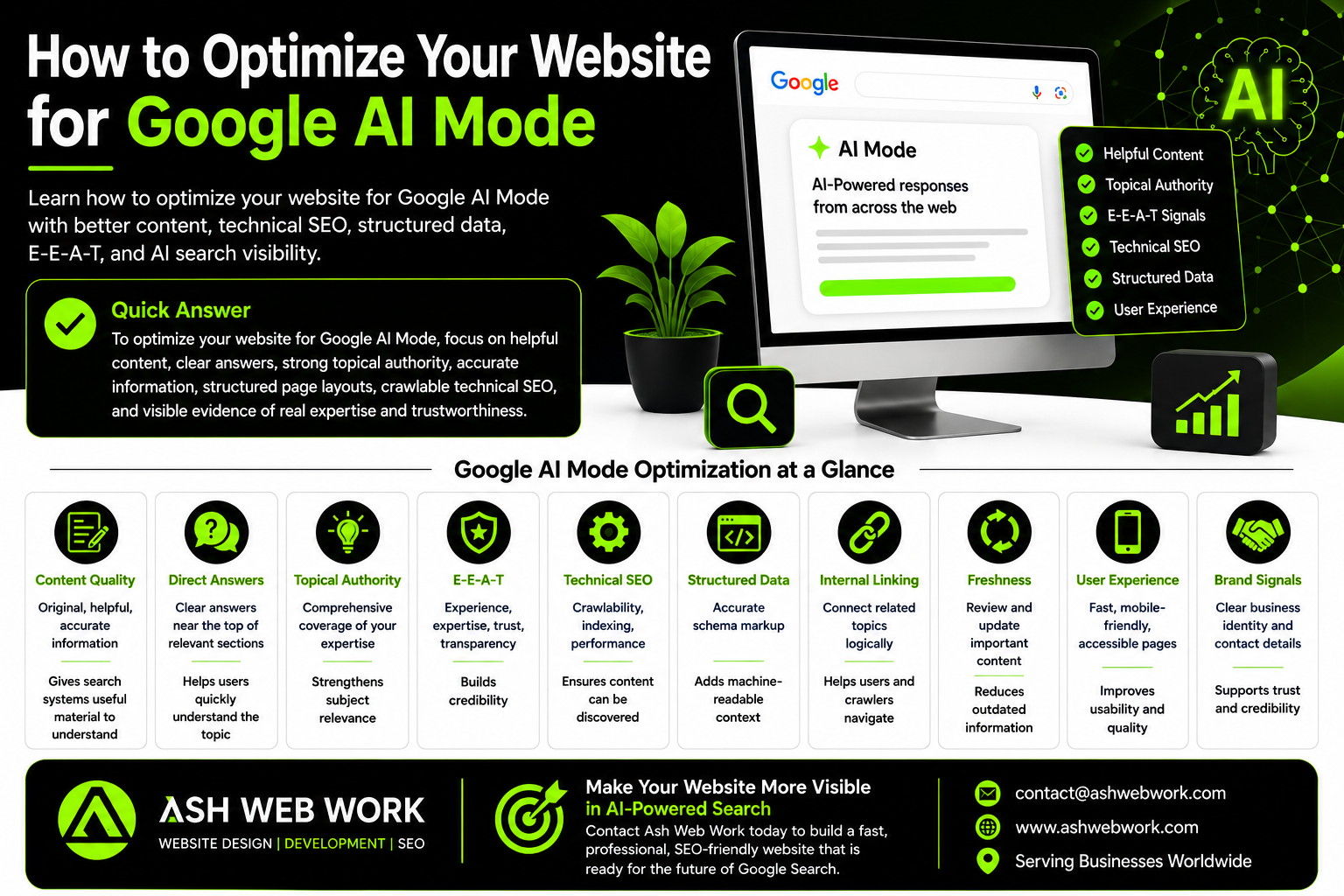
To optimize your website for Google AI Mode, focus on helpful content, clear answers, strong topical authority, accurate information, structured page layouts, crawlable technical SEO, and visible evidence of real expertise and trustworthiness. In practical terms, you should:
- Answer important questions directly.
- Create comprehensive content around your areas of expertise.
- Use clear headings and logical page structure.
- Add original insights, examples, and experience.
- Keep important information accurate and updated.
- Make your website easy for Google to crawl and understand.
- Improve page speed and mobile usability.
- Use structured data where it accurately represents your content.
- Build trust through clear business and author information.
The goal is simple: make your website a useful source that both people and search systems can understand, evaluate, and confidently reference.
Google AI Mode Optimization at a Glance
| Optimization Area | What to Focus On | Why It Matters |
|---|---|---|
| Content Quality | Original, helpful, accurate information | Gives search systems useful material to understand |
| Direct Answers | Clear answers near the top of relevant sections | Helps users quickly understand the topic |
| Topical Authority | Comprehensive coverage of your expertise | Strengthens subject relevance |
| E-E-A-T | Experience, expertise, trust, transparency | Builds credibility |
| Technical SEO | Crawlability, indexing, performance | Ensures content can be discovered |
| Structured Data | Accurate schema markup | Adds machine-readable context |
| Internal Linking | Connect related topics logically | Helps users and crawlers navigate |
| Freshness | Review and update important content | Reduces outdated information |
| User Experience | Fast, mobile-friendly, accessible pages | Improves usability and quality |
| Brand Signals | Clear business identity and contact details | Supports trust and credibility |
What Is Google AI Mode?
Google AI Mode is an AI-powered search experience designed to help users explore complex questions, compare options, and continue searching through conversational follow-up queries. Instead of searching only for short keywords, users may ask questions such as:
- “What is the best website platform for a small business with a limited budget?”
- “Compare WordPress, Shopify, and an AI website builder for an online store.”
- “How can I improve my local business website for AI search?”
- “What should I fix first if my website gets traffic but no leads?”
These questions often require more than one simple webpage to answer. This creates an opportunity for websites that provide:
- Clear explanations.
- Specific examples.
- Original insights.
- Helpful comparisons.
- Practical steps.
- Reliable information.
The websites most likely to remain useful in AI-powered search are not necessarily the ones that repeat a keyword the most. They are the websites that provide the strongest answer to the user’s actual question.
Why It Matters for Small Businesses
AI-powered search is changing how people discover information online.
A potential customer may no longer search only for: “website designer near me”
They may ask a more detailed question: “Who can build an affordable SEO-friendly website for my small business and help me generate leads?”
This shift means businesses need to think beyond individual keywords. Your website should communicate:
- What you do.
- Who you help.
- What problems you solve.
- Why you are qualified.
- How your process works.
- What makes your service different.
- What a customer should do next.
For small businesses and startups, this can actually create an opportunity. Large websites often publish broad, generic content. A smaller business may have an advantage when it can provide genuine first-hand experience, local knowledge, specific examples, and clear expertise.
For example, Ash Web Work can demonstrate expertise not simply by claiming to offer website design and SEO, but by publishing useful explanations, practical guides, project insights, and answers to questions that real business owners ask.
Traditional SEO Still Matters
One of the biggest mistakes businesses can make is assuming that AI search has replaced SEO. It has not. A website still needs a strong technical foundation. Google and other search systems need to be able to:
- Discover your pages.
- Crawl your content.
- Understand your website structure.
- Access important information.
- Evaluate page quality.
This means traditional SEO remains important. You should continue focusing on:
- Crawlable pages.
- Logical site architecture.
- Relevant titles.
- Descriptive headings.
- Internal linking.
- Mobile usability.
- Page performance.
- Secure HTTPS connections.
- Indexing management.
- Helpful content.
AI search optimization should be viewed as an extension of good SEO—not a completely separate replacement.
1. Create Content That Directly Answers Real Questions
One of the strongest ways to optimize for Google AI Mode is to understand what your audience is actually asking. Do not begin with:
“How many times can I include my keyword?”
Start with:
“What does my customer need to know?”
For example, a business targeting the phrase: affordable website design service
could create content answering questions such as:
- How much should a small business website cost?
- What is included in affordable website design?
- Can a low-cost website still be professional?
- How long does it take to build a business website?
- Is WordPress better than an AI website builder?
- What features should a small business website include?
These questions create a stronger content ecosystem than repeatedly targeting one exact phrase.
A Simple Content Formula: For important questions, use this structure:
- Give a direct answer.
- Explain the answer.
- Provide practical examples.
- Add important exceptions or limitations.
- Tell the reader what to do next.
Example
Question: Is an AI website builder good for a small business?
Direct answer: An AI website builder can work well for a simple business website, but companies that depend heavily on SEO, lead generation, branding, or custom functionality may benefit more from professional web design. Then expand the answer with:
- Cost considerations.
- Customization limitations.
- SEO requirements.
- Growth plans.
- Realistic use cases.
This structure is useful for both human readers and AI-powered search systems because the meaning of the content is clear.
2. Build Topical Authority Instead of Chasing Individual Keywords
AI-powered search is particularly relevant to websites that demonstrate a clear understanding of a subject. For example, if your business specializes in web design, publishing one article about “website design” is not enough to demonstrate broad expertise. A stronger strategy is to build topic clusters.
Example: Website Design Topic Cluster
Main Topic: Professional Website Design
Supporting Content
- How much does a small business website cost?
- Website redesign checklist.
- Essential pages for a business website.
- How to improve website conversion rates.
- AI website builder vs professional web designer.
- WordPress vs Wix vs Shopify.
- Mobile website design best practices.
- Website speed and user experience.
- Common website mistakes small businesses make.
Each article should link naturally to related content. This helps create a logical knowledge structure. For Ash Web Work, this approach can help build authority across key areas such as:
- Website design and development.
- SEO.
- AI and websites.
- WordPress and CMS platforms.
The goal is not to create hundreds of random blog posts. The goal is to become genuinely useful within the topics your business wants to be known for.
3. Put the Answer Before the Explanation
People searching through AI-powered experiences often want efficient answers. That does not mean every article must be short. It means the article should avoid unnecessary delays. A useful approach is:
- Answer First: Provide a concise response.
- Explain Second: Add the reasoning, details, examples, and context.
- Go Deeper: Include comparisons, alternatives, limitations, and practical steps.
For example:
The best way to optimize a website for Google AI Mode is to publish accurate, helpful, well-structured content supported by strong technical SEO and genuine expertise.
Then explain exactly how to achieve that. This approach also improves readability for busy business owners.
4. Demonstrate Real Experience and Expertise
Generic content is becoming easier to produce. That means original experience is becoming more valuable. Ask yourself: What can my business say that a generic AI-generated article cannot? You may be able to add:
- Real project examples.
- Before-and-after improvements.
- Screenshots of processes.
- Original research.
- Customer questions.
- Case studies.
- Lessons learned from client work.
- Industry-specific recommendations.
For example, instead of writing:
“Website speed is important.”
You could explain:
“When optimizing a business website, one of the first areas we review is image size, unnecessary scripts, plugin usage, and the mobile experience because these issues frequently create avoidable performance problems.”
That type of explanation sounds more credible because it describes an actual process.
Show Who Is Behind the Content
For important content, make it clear:
- Who created it.
- Why they are qualified.
- When it was updated.
- How readers can contact the business.
Consider maintaining:
- An About page.
- Author or company information.
- A contact page.
- Service pages.
- Privacy and policy pages where appropriate.
- Portfolio or case study pages.
Trust is not created by one paragraph at the bottom of a blog post. It is reinforced throughout the website.
5. Structure Content Clearly
A well-structured page is easier to read, navigate, and understand. Use:
- One clear H1.
- Logical H2 sections.
- H3 headings for detailed subtopics.
- Short paragraphs.
- Bullet points.
- Numbered steps.
- Tables where comparisons are useful.
Avoid turning every paragraph into a wall of text. For example:
Poor Structure: A 2,000-word article with long paragraphs, no subheadings, and repeated ideas.
Better Structure:
- Direct answer.
- Definition.
- Why it matters.
- Step-by-step process.
- Examples.
- Common mistakes.
- Best practices.
- FAQs.
- Conclusion.
The structure should reflect how people naturally learn about the topic.
6. Use Structured Data Where Appropriate
Structured data, often implemented using schema markup, provides additional context about the content on a page. Depending on your website, relevant structured data may include:
- Organization schema.
- Local business schema.
- Article schema.
- Product schema.
- Service-related information where appropriate.
- Breadcrumb schema.
However, schema markup should accurately reflect the visible content and purpose of the page. Do not add schema simply because you hope it will create a ranking advantage. Instead, use structured data to make your website’s information more clearly defined. For example, a local business should ensure its key business details are consistent, including:
- Business name.
- Address.
- Contact information.
- Service areas.
- Opening information where relevant.
The more accurately your business information is represented, the easier it is for systems to understand your online presence.
7. Make Your Website Easy to Crawl and Access
The best content cannot help your business if search systems cannot access it properly. Perform regular technical SEO checks.
Review the Following
- Indexing: Make sure important pages are eligible to be indexed.
- Robots Directives: Do not accidentally block important sections of your website.
- XML Sitemap: Maintain an updated sitemap that includes important indexable pages.
- Internal Links: Link related content together using descriptive anchor text.
- Broken Pages: Fix unnecessary broken links and important 404 errors.
- Duplicate Content: Avoid creating multiple pages that serve exactly the same purpose.
- Canonicalization: Use canonical signals appropriately when duplicate or similar versions of pages exist.
Technical SEO may not be exciting, but it provides the foundation for every other optimization effort.
8. Improve Page Speed and User Experience
AI search optimization should not distract businesses from basic website quality. Your website should be:
- Fast enough for normal users.
- Easy to navigate.
- Mobile-friendly.
- Accessible.
- Secure.
- Free from intrusive distractions.
Common improvements include:
- Compressing oversized images.
- Using modern image formats when appropriate.
- Removing unnecessary plugins.
- Reducing unused scripts.
- Using effective caching.
- Choosing reliable hosting.
- Testing the mobile experience.
A website that is difficult to use is unlikely to create a good experience even if it receives more visibility.
9. Create Content for Conversations, Not Just Keywords
Traditional keyword research is still valuable. But AI-powered search encourages businesses to think about complete conversations. Instead of creating a page only around: “WordPress website design”. consider the related questions:
- Is WordPress good for a small business?
- How much does a WordPress website cost?
- Is WordPress better than an AI website builder?
- What plugins does a business website need?
- How do I maintain a WordPress website?
- Can WordPress help with SEO?
This approach helps you understand the entire customer journey. A potential customer may begin with an informational question and later search for a service provider. Your content should support that journey.
10. Keep Important Content Updated
AI-powered search systems can surface information that answers current questions. Outdated information can reduce the usefulness of your content. Review pages that contain:
- Prices.
- Statistics.
- Software versions.
- Product comparisons.
- Search features.
- Technical instructions.
- Industry recommendations.
A useful content maintenance process includes:
- Review high-value pages regularly.
- Check for outdated information.
- Replace obsolete examples.
- Add new insights.
- Improve weak sections.
- Check internal links.
- Update metadata if the page’s focus has changed.
Do not change a date without making meaningful improvements. A real update should improve the value of the content.
11. Optimize for Brand Understanding
Google AI Mode and other AI search systems may need to understand not only individual pages, but also who is behind the information. Your website should clearly communicate your identity. Make sure visitors can easily understand:
- Your business name.
- Your services.
- Your areas of expertise.
- Who you serve.
- How to contact you.
- Where you operate, if location is relevant.
For a service business such as Ash Web Work, consistency matters. Your website, social profiles, business listings, and other official online properties should communicate a clear and consistent brand identity. Avoid confusing visitors with different business names, outdated contact information, or unclear service descriptions.
12. Use Internal Links to Build Context
Internal linking remains one of the simplest ways to improve website structure. For example, an article about Google AI Mode optimization could link naturally to articles about:
- Technical SEO.
- E-E-A-T.
- AI SEO strategies.
- Website speed.
- Structured data.
- WordPress SEO.
Good internal links help:
- Visitors discover related information.
- Search engines understand page relationships.
- Important pages receive contextual signals.
- Users stay engaged with useful content.
Avoid adding links only for the sake of adding links. Every internal link should provide a logical next step.
Common Mistakes to Avoid When Optimizing for Google AI Mode
- Trying to Find a Secret AI Keyword Formula: There is no sustainable strategy based on repeating phrases such as: “Google AI Mode optimization” throughout every paragraph. Focus on answering the topic comprehensively.
- Publishing Large Volumes of Generic AI Content: More content does not automatically mean more authority. A smaller number of useful, original articles can be more valuable than hundreds of repetitive pages.
- Ignoring Traditional SEO: AI-powered search does not remove the need for:
- Crawlability.
- Indexing.
- Website structure.
- Mobile optimization.
- Performance.
- Writing Only for Search Systems: Your website ultimately needs to help people. Avoid unnatural writing designed only to manipulate algorithms.
- Making Unsupported Claims: Credibility is especially important when discussing new technology. Do not claim:
- Guaranteed rankings.
- Secret AI Mode ranking factors.
- Automatic visibility.
- Results that cannot be verified.
- Neglecting Your Brand: A technically optimized website with weak trust signals may still struggle to convince potential customers. Show who you are and why people should trust you.
- Forgetting to Update Important Pages: Old software advice, outdated statistics, and obsolete recommendations can reduce content quality. Create a regular review process.
Best Practices for Google AI Mode Optimization
Here is a practical framework for businesses.
- Start With Customer Questions: Turn the most valuable questions into genuinely useful content. Collect questions from:
- Customers.
- Sales calls.
- Support requests.
- Email inquiries.
- Search suggestions.
- Industry discussions.
- Answer Clearly: Place concise answers near the beginning of important sections. Then provide supporting details.
- Add Original Value: Include:
- Examples.
- Experience.
- Case studies.
- Screenshots.
- Expert commentary.
- Practical recommendations.
- Build Topic Clusters: Create related content instead of isolated articles. Connect those pages with useful internal links.
- Maintain Technical Quality: Regularly check:
- Indexing.
- Mobile usability.
- Page performance.
- Broken links.
- Sitemap health.
- Strengthen Trust: Make it easy to identify:
- The author or business.
- Contact information.
- Relevant experience.
- Services offered.
- Measure What Matters: Do not focus only on rankings. The goal of visibility is business growth, not simply more impressions. Also monitor:
- Organic traffic.
- Qualified leads.
- Engagement.
- Conversions.
- Important landing pages.
- Content performance.
A Practical Google AI Mode Optimization Checklist
Use this checklist to review your website:
- Important pages are crawlable and indexable.
- Every key page has a clear purpose.
- Content answers real customer questions.
- Important questions have direct answers.
- Articles use logical heading structures.
- Content includes original insights or experience.
- Facts and important claims are reviewed for accuracy.
- Business and author information is easy to find.
- Related pages are connected with internal links.
- Relevant structured data is implemented accurately.
- The website is mobile-friendly.
- Important pages load efficiently.
- Outdated content is reviewed and improved.
- Calls to action are clear.
- Content supports the customer’s journey from question to decision.
Frequently Asked Questions
1. Can I specifically optimize my website for Google AI Mode?
You can optimize your website for the qualities that make content useful and understandable in AI-powered search experiences. This includes helpful content, clear answers, strong topical coverage, technical accessibility, structured information, and credible evidence of expertise. There is no need to create a completely separate website for AI Mode. Strong SEO and high-quality content remain the foundation.
2. Does Google AI Mode require special schema markup?
There is no universal “Google AI Mode schema” that guarantees visibility. However, relevant structured data can help provide machine-readable context about your organization, articles, products, and other content when implemented correctly. Use schema because it accurately describes your content, not because you expect an automatic ranking benefit.
3. Should I rewrite all my existing content for AI search?
No. Start by auditing your most important pages. Review whether they:
- Answer the user’s question.
- Contain accurate information.
- Are easy to navigate.
- Demonstrate expertise.
- Include useful examples.
Improve weak content rather than rewriting everything without a clear reason.
4. Is traditional SEO still important for Google AI Mode?
Yes. Traditional SEO remains essential because your website still needs to be discoverable, crawlable, understandable, and useful. Technical SEO, site structure, page quality, internal linking, and mobile usability remain important parts of a strong optimization strategy.
5. Does AI-generated content rank in Google AI Mode?
Content should be evaluated based on its usefulness and quality rather than simply whether AI was involved in creating it. However, publishing unedited, generic, or inaccurate AI-generated content is risky because it may provide little unique value. Use AI to improve your workflow, then add human expertise, fact checking, originality, and real-world experience.
6. How can a small business improve its chances of appearing in AI-powered search?
Small businesses should focus on becoming a credible source within their area of expertise. Publish useful answers, clearly explain your services, maintain accurate business information, demonstrate real experience, build strong local and topical relevance, and ensure your website is technically accessible. A small business does not need to publish the most content. It needs to publish content that is genuinely more useful for its target audience.
7. How long does it take to optimize a website for Google AI Mode?
The timeline depends on your website’s current condition, competition, technical health, and content quality. Some improvements, such as clearer headings or better internal links, can be implemented quickly. Building topical authority and long-term organic visibility takes consistent effort. The best approach is to treat AI search optimization as an ongoing part of your SEO and content strategy rather than a one-time project.
Conclusion
Optimizing your website for Google AI Mode does not require abandoning everything you know about SEO. In many ways, the fundamentals are becoming even more important. Create content that genuinely helps people. Answer questions clearly. Demonstrate real expertise. Keep information accurate. Build a technically strong website. Organize your content logically and make it easy for users to trust your business.
Key Takeaways
- Google AI Mode optimization starts with helpful, people-first content.
- Clear answers and logical structure make content easier to understand.
- Topical authority is more valuable than publishing random keyword-focused articles.
- Original experience and expertise can differentiate your website from generic content.
- Traditional technical SEO remains essential.
- Accurate structured data can provide additional context.
- Website speed, mobile usability, and trust signals still matter.
- AI search optimization should be part of a long-term content and SEO strategy.
Ready to Make Your Website More Visible in AI-Powered Search?
The search landscape is changing quickly, and simply publishing more content is no longer enough.
Your website needs a strong combination of SEO, helpful content, technical performance, user experience, and genuine expertise.
Ash Web Work helps small businesses, startups, and local businesses improve their online presence through professional website design, WordPress development, SEO strategy, technical optimization, and AI-ready content planning.
Whether you need to improve an existing website or build a stronger foundation for future search visibility, the right strategy can help your business attract the right audience and turn more visitors into customers.
Contact Us today to build a fast, professional, SEO-friendly website that is ready for the future of Google Search and AI-powered discovery.